.svg)


We are living in a time when we must begin to prioritize the why over the how, and nowhere is this more urgent than in the way we build artificial intelligence infrastructure.
For years, the dominant narrative has been scale. Bigger models. Larger datasets. More compute. Faster training cycles. Entire industries have aligned themselves around the belief that progress in AI is a function of magnitude.
But scale, on its own, is not intelligence. And it is certainly not resilience.
Sovereignty and Scale
The question is no longer how far we can push AI systems. The question is who governs them, where they reside, and whether they remain within the boundaries we define.
Because infrastructure, at its core, is about sovereignty.
Data is no longer just an asset. It is jurisdiction. It is exposure. It can become a risk. Every dataset that leaves a controlled environment, every model trained on unverified inputs, and every system deployed without clear boundaries introduces a layer of dependency that cannot be easily reversed.
And dependency, at scale, becomes vulnerability.
Control means knowing where your data lives. Physically and digitally.
It means ensuring that data is processed within defined jurisdictions, under known regulations, and within systems that are auditable and secure by design. It means that access is not assumed, but explicitly granted, monitored, and revocable.
Without this, AI infrastructure becomes a distributed surface of uncertainty.
Sovereignty is not about isolation. It is about authority.
Physical Security Complements Its Digital Counterpart
To build sovereign AI systems is to ensure that organizations, institutions, and nations retain the ability to govern their data, their models, and their infrastructure without relying on opaque external dependencies. It is the difference between using technology and being subject to it.
But sovereignty without security is an illusion.
Digital security alone is not sufficient. Encryption, access control, and network protections are essential, but they operate within a broader system that includes physical infrastructure. Data centers, compute clusters, energy systems; these are tangible assets, exposed to physical risks, operational failures, and geopolitical realities. And a secure system cannot exist in an insecure environment.
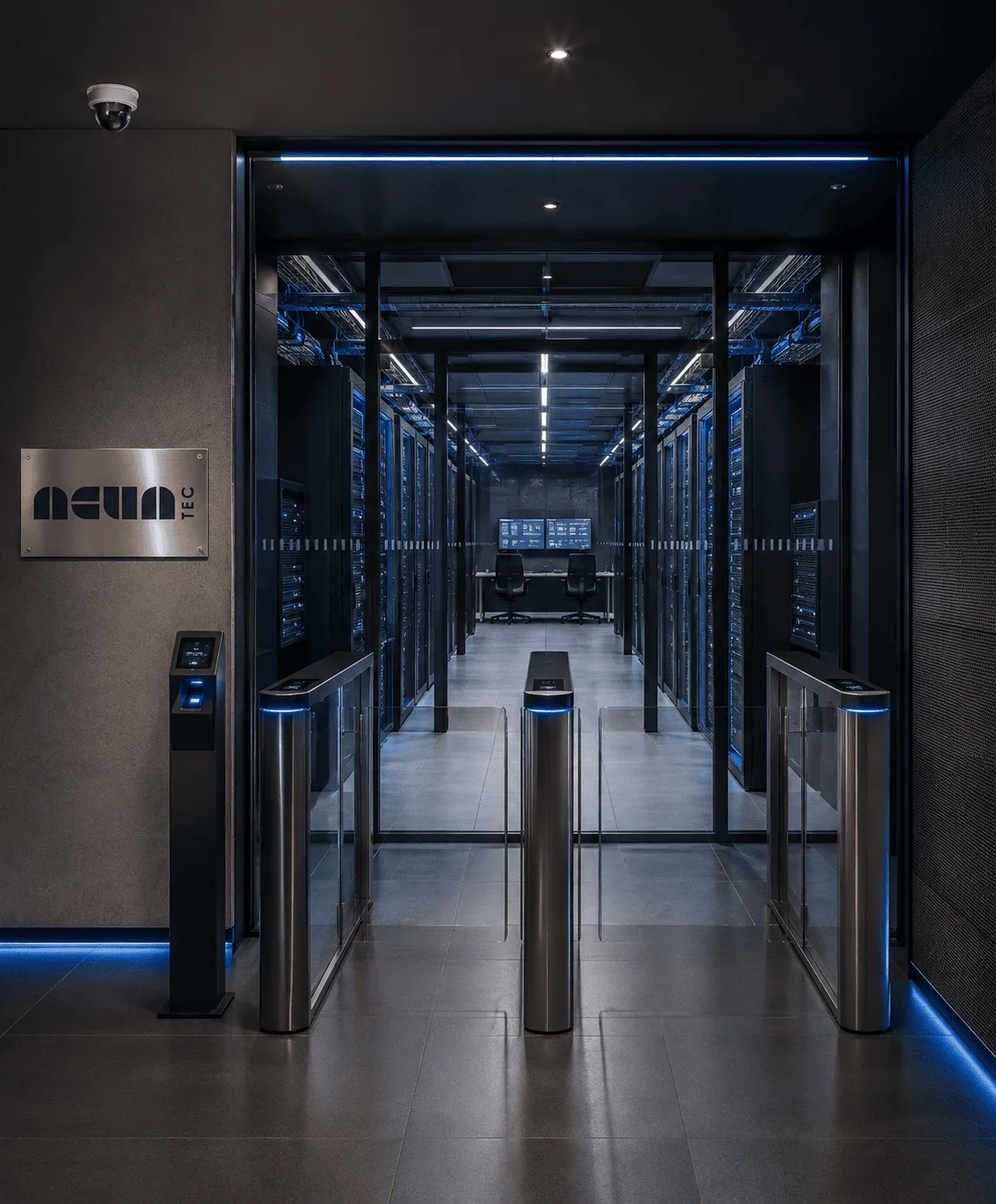
Physical security must be treated as a foundational layer of AI infrastructure. Who has access to the hardware? Where is it located? How is it protected? What redundancies exist? These are not operational details. They are defining characteristics of whether a system can be trusted.
Because a breach is not always digital.
Control, therefore, is multi-dimensional. It is data sovereignty, digital security, and physical integrity working as a single system.
And yet, much of today’s AI ecosystem is built on abstraction. Cloud layers that obscure location. Services that mask underlying dependencies. Platforms that offer convenience in exchange for visibility.
This abstraction enables scale. But it erodes control.
When organizations cannot trace where their data flows, when they cannot verify how their models are trained, when they cannot physically account for the infrastructure they depend on, they are no longer operating systems, they are participating in them.
This is not a sustainable foundation for critical technologies. AI is increasingly embedded in systems that matter: healthcare diagnostics, financial decision-making, energy distribution, national infrastructure. In these contexts, uncertainty is not acceptable.
Control is a requirement, not a preference, and this requires a shift in how we define performance.
It is no longer enough to measure throughput, latency, or model accuracy in isolation. We must measure containment. We must measure traceability. We must measure the ability to operate independently, securely, and reliably under real-world conditions. A system that performs well but cannot guarantee data integrity or physical security is not advanced. It is exposed.
The future of AI infrastructure must be designed as an integrated system where energy, hardware, and software are aligned with governance, jurisdiction, and security from the outset. Not as an afterthought. Not as a compliance layer. But as a core design principle.
This is what control looks like in practice.
meum tec Closed AI: A Multi-Dimensional Control
This is where meum tec’s approach to closed AI infrastructure begins. Not as a product layer, but as an architectural decision.
Closed AI is not about restriction. It is about creating environments where every component, data, compute, access, and operation, exists within clearly established boundaries. Boundaries that are known, controlled, and enforceable.
In a closed system, data does not drift. It does not move across invisible layers or into undefined jurisdictions. It remains within a controlled environment where its lifecycle, from ingestion to processing to storage, is fully traceable. This is the foundation of sovereignty.
Closed AI redefines infrastructure ownership. Instead of relying on distributed, opaque cloud layers, infrastructure becomes tangible again. It is located. It is secured. It is governed. Organizations know where their systems operate, who has access to them, and under what conditions.
This is not a regression. It is a necessary correction.
Physical infrastructure becomes an active part of the security model. Data centers are not just facilities; they are controlled environments with defined access protocols, monitored conditions, and operational resilience. Compute is not just scalable; it is contained within systems that are designed to withstand both digital and physical threats.
Because control cannot exist without presence. At the same time, closed AI does not reject performance. It refines it. This leads to a different kind of scalability.
Not expansion without limits, but growth within structure. Systems scale in a way that preserves integrity, rather than diluting it. Each additional layer is integrated, not appended. And integration is what transforms infrastructure into a system.
Closed AI also enables a more responsible relationship with energy and resources. When infrastructure is controlled, energy consumption can be aligned with availability, with efficiency targets, and with environmental constraints. Waste is reduced not through offsets, but through design.
This is where infrastructure becomes accountable to the physical world it operates within. In critical sectors, this approach is not optional.
Healthcare systems cannot rely on data flows they cannot trace. Financial institutions cannot operate on models they cannot audit. National infrastructure cannot depend on compute they do not control.
Closed AI provides the operational certainty these environments require.
It ensures that systems behave as intended, within defined parameters, under known conditions. It reduces the surface of uncertainty and replaces it with measurable, enforceable structure.
This is not about limiting innovation. It is about creating the conditions in which innovation can be trusted.
At meum tec Closed AI, infrastructure is designed as a unified system where sovereignty, security, and performance are not competing priorities, but aligned principles. Energy, hardware, and software are integrated with governance and physical control from the outset.
The result is infrastructure that can be understood, operated, and relied upon. Not because it is larger. But because it is controlled.
And in a world where AI is becoming foundational to how we make decisions, allocate resources, and define systems, control is not a constraint on progress. It is the only way to ensure that progress remains ours to define.
Because without control, scale amplifies risk. It extends vulnerabilities across larger surfaces, across more systems, across more critical functions. It makes failures harder to contain and consequences harder to predict.
But with control, scale becomes meaningful. It becomes structured, intentional, and sustainable.
At meum tec, we believe that AI infrastructure must be built with sovereignty at its core. Systems must be designed to operate within defined boundaries, with full visibility over data flows, infrastructure layers, and access points. Security must extend beyond code into the physical world, where infrastructure exists and operates.
This is not a constraint. It is a responsibility.
The future of AI will not be defined by how much we can build. It will be defined by what we are able to protect.